Call 303-388-6886Call us

What we treat

Two dogs can have the same diagnosis and need completely different help, because each has found their own way to work around it. Your veterinarian tells you what is wrong. We look at how your pet is actually moving because of it.

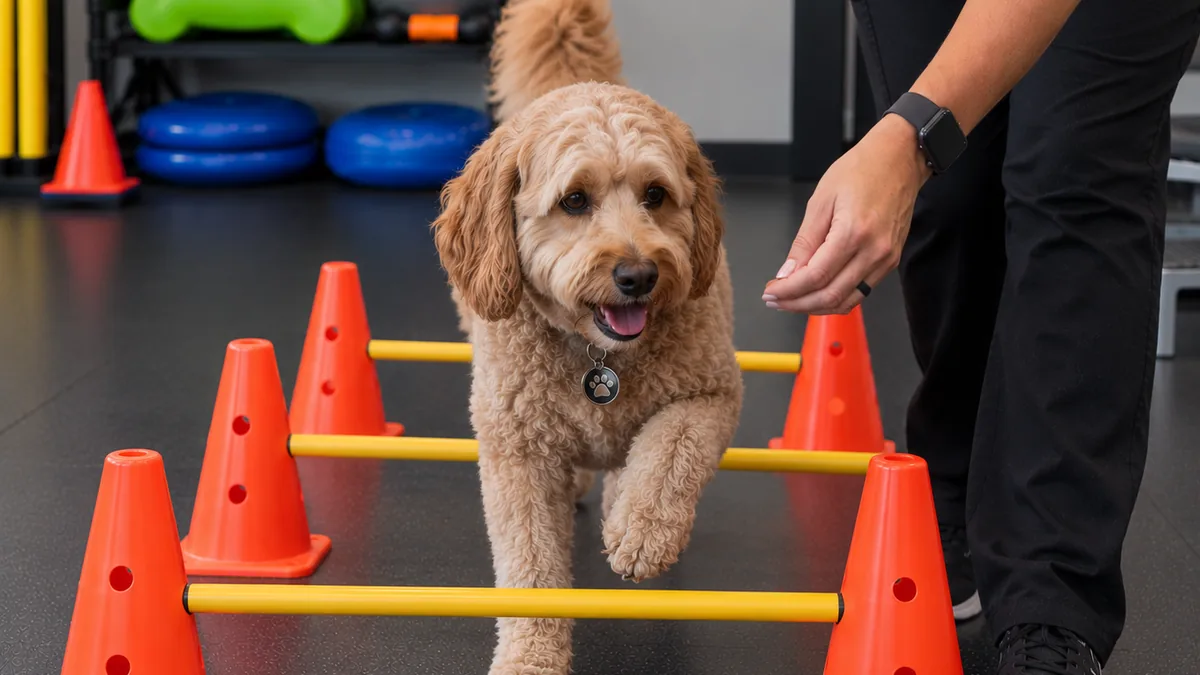
A goldendoodle stepping over a low pole between cones while a practitioner guides him forward with a treat

Start with what you have noticed

Most Pet Parents arrive describing a moment rather than a diagnosis. If one of these is closer to what you are seeing, start there.

Conditions we see most

  • IVDD, intervertebral disc disease Surgery is not the only path for every disc case. Recent research supports conservative care, rest, pain control and structured rehabilitation, for certain dogs.
  • Degenerative myelopathy A progressive disease of the spinal cord in older dogs. Rehabilitation is the only approach shown to slow how quickly it progresses, by keeping a dog stronger for longer.
  • Vestibular disease Sudden head tilt, circling and loss of balance in an older dog, similar to vertigo in people. Gentle hands-on therapy can shorten a recovery that would otherwise drag.
  • Arthritis and joint pain The most common reason dogs slow down, and the most often put down to age alone. There is usually far more available than a daily tablet.
  • Recovery after surgery Knee, hip, spinal and elbow procedures. The repair is only half of it, the muscle, the symmetry and the confidence are the other half.
  • Cats Arthritis, lumbosacral disease, recovery after surgery and mobility loss in cats, a whole side of the practice.

Call 303-388-6886

What else we treat

The practice treats a good deal more than the conditions above. Orthopedic dysfunction and degenerative joint disease. Ligament, tendon and muscle strains, sprains and tears. Peripheral neuropathy, fibrocartilaginous embolism, ataxia and wobblers. Hip dysplasia. Discospondylosis.

And some of the more frustrating cases where the tools available in clinical medicine are not enough on their own, chronic wounds, inflammatory conditions, recovery after whelping and caesarean, seizures, ear infections, pain syndromes where medication is already maxed out, incontinence and recurrent urinary infections.

If your pet’s problem is not listed, that does not mean we cannot help. Call and describe it.
When it is urgent

Go straight to your veterinarian if your pet has suddenly lost the use of their back legs, cannot stand, has lost bladder or bowel control, or is in severe pain. That is an emergency. Rehabilitation matters afterwards, a veterinarian comes first.

Call 303-388-6886

Questions

Questions we get asked

What conditions does Rehab 4 Pets treat?

Arthritis and degenerative joint disease, IVDD and disc problems, degenerative myelopathy, vestibular disease, recovery after knee, hip, spinal and elbow surgery, hip dysplasia, ligament, tendon and muscle injuries, peripheral neuropathy, fibrocartilaginous embolism, ataxia and wobblers, discospondylosis, and cats with lumbosacral disease, arthritis and mobility loss.

My dog has a diagnosis already, what does rehabilitation add?

Two dogs can have the same diagnosis and need completely different help, because each has found their own way to work around it. Your veterinarian tells you what is wrong; we look at how your pet is actually moving because of it, what they have quietly stopped doing, what they are bracing against, and what can be built back.

When is it an emergency rather than a rehabilitation question?

Go straight to your veterinarian if your pet has suddenly lost the use of their back legs, cannot stand, has lost bladder or bowel control, or is in severe pain. That is an emergency. Rehabilitation matters afterwards, a veterinarian comes first.

What if my pet’s condition is not listed?

That does not mean we cannot help. The practice treats a good deal more than the pages here cover, including chronic wounds, inflammatory conditions, recovery after whelping, incontinence and recurrent urinary infections. Call and describe it.

Read more

Read more on this

Call 303-388-6886

Start with a phone call

Tell us what you’ve noticed. We’ll tell you honestly whether we think we can help.

Call 303-388-6886