Call 303-388-6886Call us

Degenerative myelopathy: what can still be done

Rehabilitation for dogs with degenerative myelopathy in Colleyville, Texas.

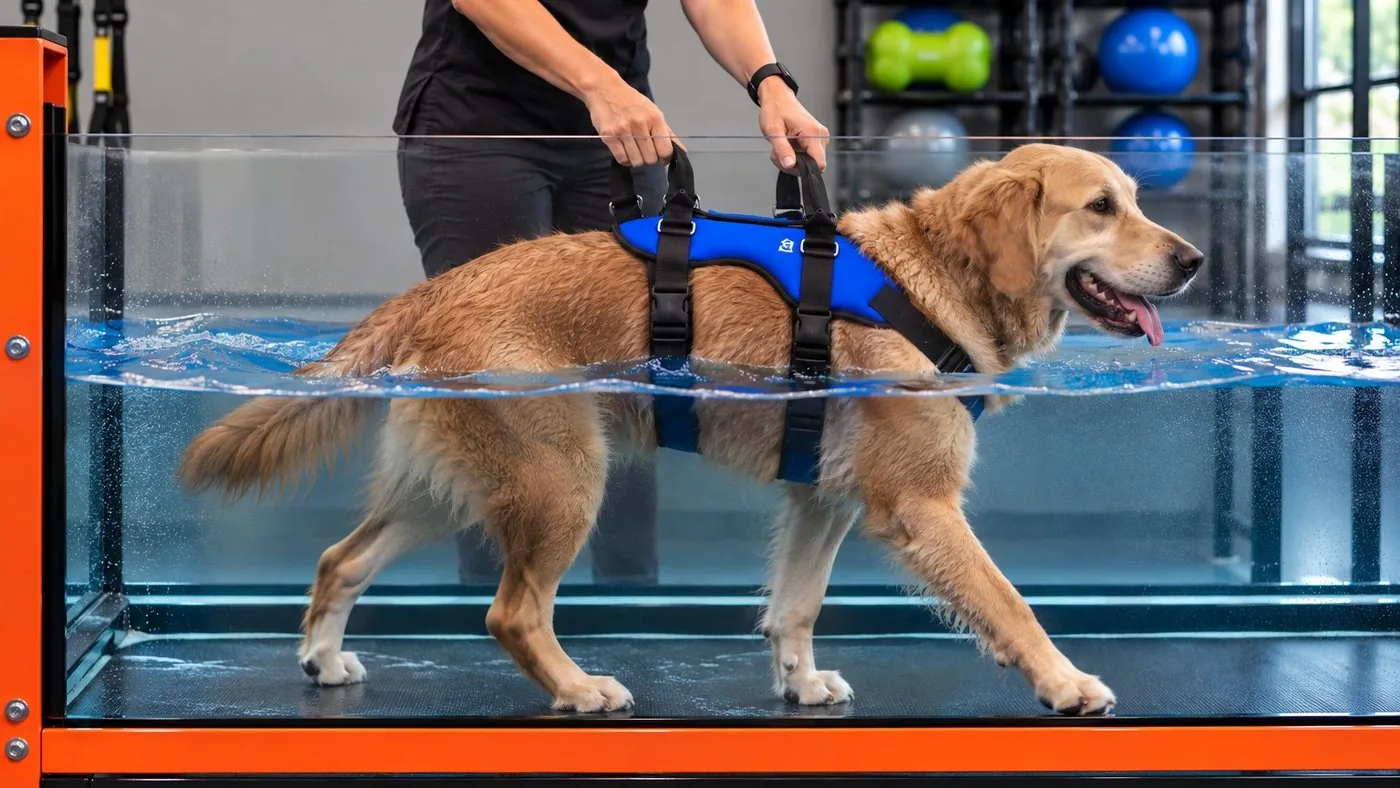
A dog in a support harness walking steadily in the underwater treadmill, water up to his chest

If your dog has just been given this diagnosis, you have probably already been told there’s no cure. That’s true, and we won’t pretend otherwise anywhere on this page.

What’s also true, and told to Pet Parents far less often, is that rehabilitation is the one approach shown to slow how quickly it progresses. That’s not a small thing. It’s the difference between months and, for some dogs, considerably longer.

What it is

Degenerative myelopathy is a progressive disease of the spinal cord, seen in older dogs. The weakness worsens over time until a dog is no longer able to walk.

The course usually runs from around six months to a year before dogs become paraplegic. Where it progresses further, control of the bladder and bowels can be lost, and weakness eventually develops in the front legs too.

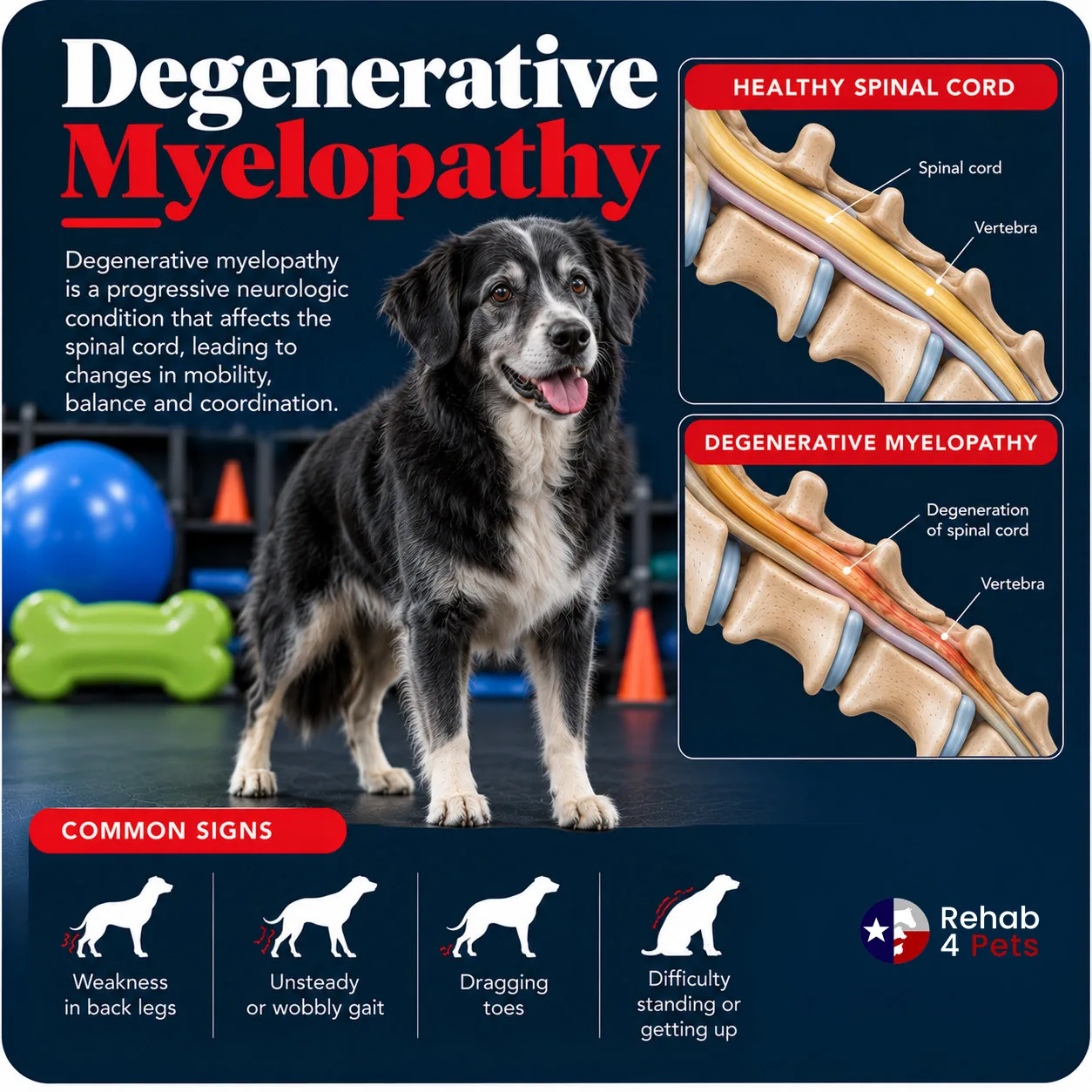
The spinal cord carries the brain’s instructions down to the back legs. In degenerative myelopathy the cord itself gradually breaks down, so less of that message arrives. The vertebrae and discs around it are usually unaffected — the legs are not the problem, the signal reaching them is.

It’s most often seen in German shepherds, boxers, corgis, Bernese mountain dogs and Rhodesian ridgebacks, though it appears in many breeds. Onset is typically around nine years of age.

One thing that surprises many Pet Parents: it isn’t painful. What they lose is control, not comfort.

A senior dog beside a healthy canine spinal cord and one affected by degenerative myelopathy.

Call 303-388-6886

What it usually looks like first

  • One back leg starting to scuff or drag
  • Wearing down the nails on one back foot
  • A paw that knuckles over so the dog walks on the top of it
  • Back legs crossing, or swaying when walking
  • Difficulty getting up, particularly on smooth floors
  • No sign of pain, no yelping, no flinching when touched

It nearly always begins in one back leg rather than both. Your veterinarian will want to rule out other causes, since several conditions look similar early on.

Why rehabilitation matters here specifically

With most conditions, rehabilitation is one option among several. With this one it is the only approach shown to change the course of the disease.

The stronger a dog stays, the slower the progression tends to be.

Muscle that’s kept working keeps a dog on their feet longer, and every week on their feet is a week of the life they recognize.

The work focuses on building muscle tone, endurance and stamina, and on the compensations that develop elsewhere. As the back end weakens, dogs shift enormous effort into their front legs and spine. Left alone, those areas become sore and tired, and that soreness costs mobility of its own.

So while the outcome is not something anyone can change, the pace of it and the comfort along the way genuinely can.

Call 303-388-6886

What a program involves

  • Water treadmill work. The water carries much of your dog’s weight, so they can keep using their back legs long after that’s difficult on land.
  • Targeted strengthening. Specific exercises to hold muscle for as long as possible, with things to continue at home between visits.
  • Treating the compensations. Manual therapy and chiropractic care for the spine and front legs, which are quietly taking on far more work.
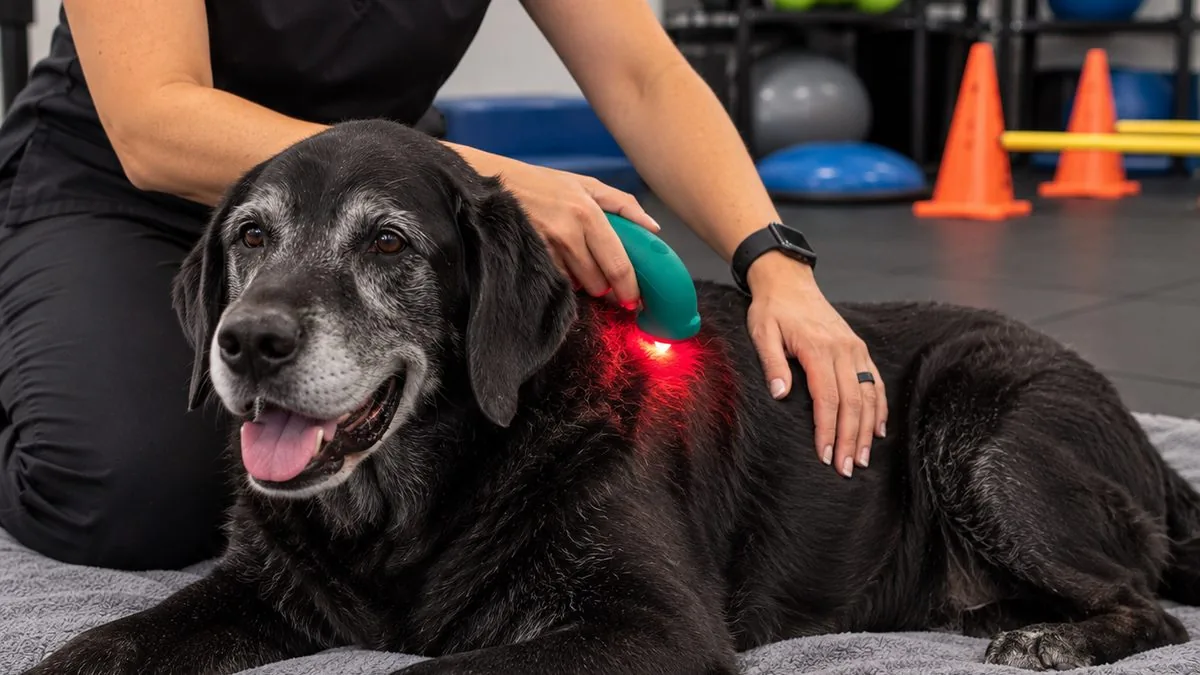
  • Laser therapy. Some research suggests it may help slow progression. The evidence isn’t settled, and we’ll be straight with you about that.
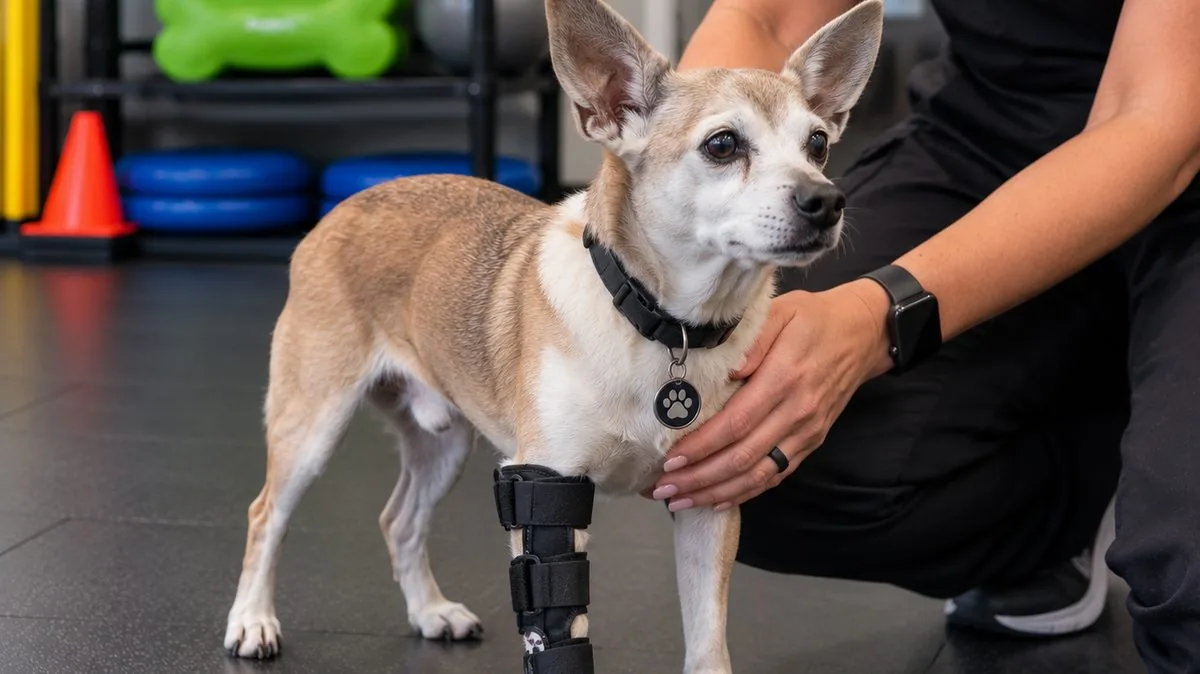
  • Carts, harnesses and support devices. Timing matters, introduced at the right moment, a cart extends independence rather than signalling the end of it.
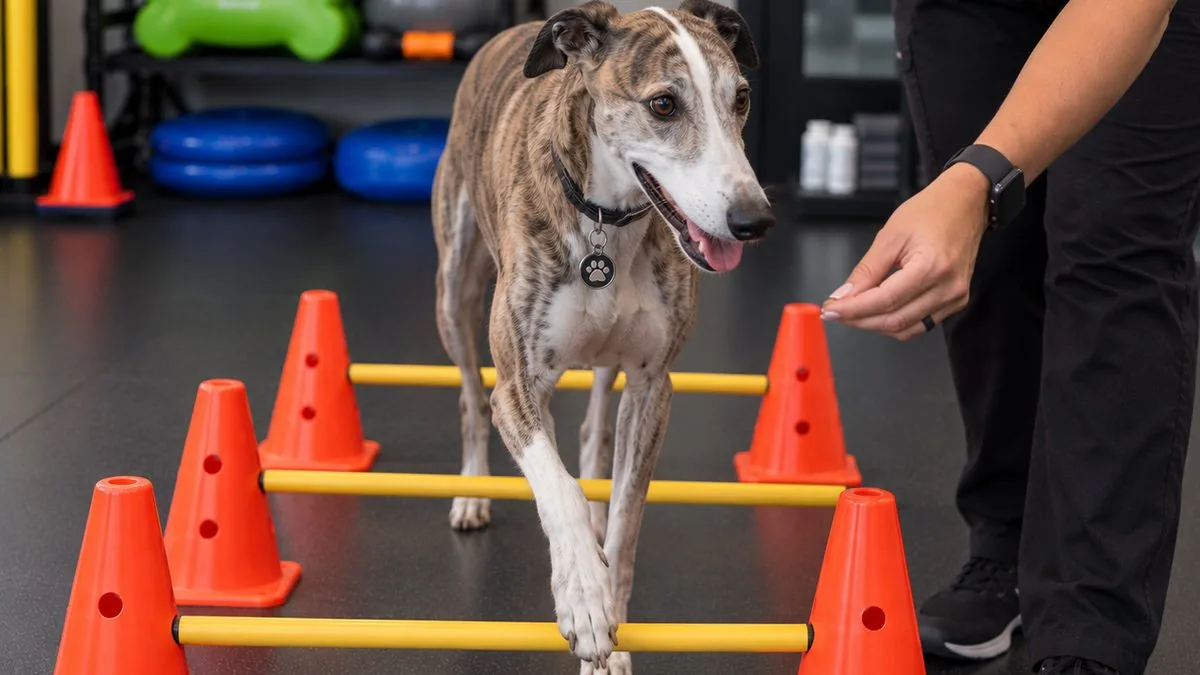
  • Coordination work. Exercises that help a dog stay aware of where their back feet are, for as long as that awareness lasts.

What we won’t tell you

We won’t tell you this can be reversed, because it can’t. We won’t give you a number of months, because the range is wide and your dog is not a statistic.

What we will do is be honest at every stage about what’s working and what isn’t, including telling you when we don’t think more visits are the right thing.

Call 303-388-6886

Something to do at home today

Cover every slick floor your dog crosses

Runners, yoga mats, rugs, especially between their bed and the door. A dog whose back legs are unreliable spends real energy just staying upright on tile, and every slip takes confidence with it. This is the single most useful thing most Pet Parents can do in the first week, and it costs almost nothing.

Check the tops of the back paws

If they’re scuffed or worn, protective boots are worth asking us about, the skin there breaks down quickly once a paw starts knuckling.

Questions

Questions we get asked

Can anything slow degenerative myelopathy in dogs?

Rehabilitation is the one approach shown to slow how quickly degenerative myelopathy progresses. The principle is that the stronger a dog stays, the slower the progression tends to be. Muscle that is kept working keeps a dog on their feet longer. The disease cannot be reversed, but its pace and the comfort along the way genuinely can change.

What are the first signs of degenerative myelopathy in dogs?

It nearly always begins in one back leg rather than both. Early signs include one back leg scuffing or dragging, nails wearing down on one back foot, a paw knuckling over so the dog walks on the top of it, back legs crossing or swaying, difficulty getting up on smooth floors, and no sign of pain at all.

Is degenerative myelopathy painful for dogs?

No. Dogs with degenerative myelopathy are usually not in discomfort. What they lose is control, not comfort, which surprises many Pet Parents and is worth knowing.

How fast does degenerative myelopathy progress?

The course usually runs from around six months to a year before dogs become paraplegic. Where it progresses further, control of the bladder and bowels can be lost, and weakness eventually develops in the front legs too. The range is wide and no honest practitioner will give you a number for your own dog.

Which breeds get degenerative myelopathy?

It is most often seen in German shepherds, boxers, corgis, Bernese mountain dogs and Rhodesian ridgebacks, though it appears in many breeds. Onset is typically around nine years of age.

Treatments

How we may help

See all treatments

Where to start

Speak to your veterinarian first, a diagnosis matters here, because several conditions look similar in the early stages and some of them are treatable.

Call 303-388-6886