
The place of myofascial treatment in canine chronic pain
For Veterinary Professionals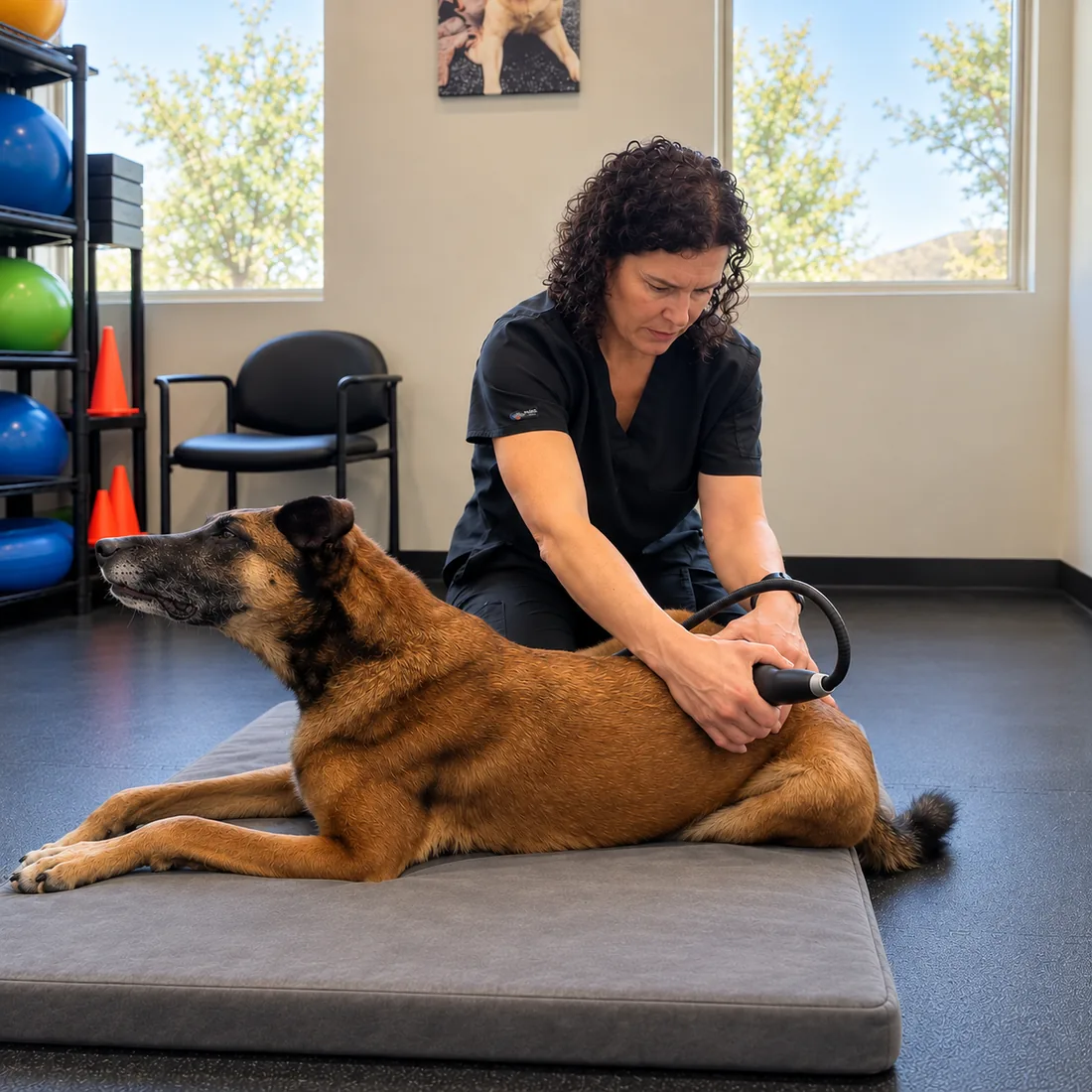
Managing chronic pain in canine patients is a complex challenge. Medication, surgery and conventional therapy all play a vital role, but they do not always fully address the root of the discomfort. Myofascial treatment is gaining traction among practitioners looking for integrative methods to improve outcomes.
What myofascial treatment is, and why fascia matters in dogs
Fascia, the tissue surrounding muscles and organs, is the body’s connective framework. When it becomes restricted through injury or inflammation, it causes discomfort and limits movement. Myofascial treatment uses gentle manual pressure to release that tension and restore function.
The reason this matters so much in dogs is proportion. Canine muscle mass runs roughly 44 to 57 percent of body weight, which makes muscle the largest organ in the body, and raises the consequence of fascial restriction accordingly.
What the evidence looks like
One study of 48 dogs with myofascial pain syndromes applied weekly trigger point stimulation. Thirty-four of them, about 70 percent, achieved complete recovery, after an average of about 2.8 weeks of treatment.
That is a single study on a modest cohort, and it should be read as such. But it is consistent with what tends to be seen clinically.
Where it helps
Pain management. It offers something to reach for where conventional approaches have not fully resolved the problem.
Restoring mobility. Releasing fascial restriction can restore flexibility in dogs dealing with stiffness and difficulty moving, and can support post-operative healing by improving blood flow to the area.
Chronic conditions. Intervertebral disc disease, hip dysplasia and arthritis are all conditions where myofascial work can sit usefully inside a broader treatment plan.
Tolerance. It is low-stress and does not require aggressive intervention, which matters for patients who will not tolerate much else.
In practice
For a practice, the case is straightforward enough: it widens the range of non-invasive options available, it tends to improve outcomes when integrated rather than used alone, and clients respond well to being offered something that prioritizes long-term function.
It is not a replacement for conventional care. It is a well-supported addition to it, and for the right patient it is the piece that was missing.
What a session looks like
A session starts with watching the dog stand and move, then palpating along the muscles to find taut bands, trigger points and areas where the fascia is restricted or tender. Treatment is gentle, sustained pressure held until the tissue softens, rather than deep or fast work, and the dog's response guides how much is done. Most patients relax into it.
It works best as one part of a plan. Releasing a restriction gives a window of better movement, and exercise is what keeps it. That is why we pair hands-on work with a home program and, where it fits, underwater treadmill work.
Responses vary. Some dogs change after one or two sessions, others need several before the pattern shifts, and some respond better to other approaches. We reassess as we go and say so when something is not helping.
If you have a patient with chronic pain who has not fully settled on conventional management, you can refer them through our vet referral form.
Related reading: Myofascial techniques in veterinary rehabilitation: a review · Assessing stiffness: muscle, soft tissue or joint capsule?
Questions colleagues ask
Which patients are good candidates for myofascial treatment?
Dogs with chronic pain or stiffness that has not fully resolved on medication and exercise alone, dogs with compensatory muscle tension from orthopedic or spinal conditions, and patients who do not tolerate more intensive handling.
Can it be used alongside medication?
Yes. It is intended to sit alongside conventional pain management, not replace it. Any changes to medication stay with the dog's own veterinarian.
How many sessions does it usually take?
It varies with the dog and the problem. We reassess at each visit, and if a patient is not responding within a few sessions, we change the approach rather than carrying on.